www.StayInPlace.org
DAASE
  • Welcome
  • News & Views
  • About
    • Mission + Vision
    • Code Of Ethics
    • Basics
    • Leadership
    • Need More Info?
  • Hire A DAASE Member
  • Welcome New Members
  • For Members Only
  • Big Picture Ideas

Thinking Outside The Norm Is The Way To Stay In Place. 

6/29/2014

0 Comments

 
Picture
We've known this for quite a while: Boomers remain in a state of aging denial. No surprise.  

Boomers, those born between 1946 and 1964,  have been active thru their lives, have had achieved higher levels of education, experienced  the benefits of better health care and have generally seen more personal income than prior generations giving them certain freedoms.  

Yet when you chat with them about creating homes that support their continued independence, they don't think it applies to them.  So when does it apply?  Boomers sure are a hard nut to crack so sometimes you have to think about different ways to communicate the values and benefits of staying in place. 

Perhaps it is time to consider different kinds of options.  
And boomers sure do like to have options.

In this article from Forbes Magazine, the author provides a look at different community models that just may be the key to acceptance.  Take a look.

"If 90% of adults over 65 want to remain in their homes as long as possible, as a 2011 AARP study suggests, why do so many wind up in retirement communities, assisted living facilities and nursing homes?"

"This was the key question at the National Aging In Place Council’s (NAIPC) annual meeting held this week in Washington, D.C."

"Meeting the needs of millions of individuals with different incomes, a range of health conditions and diverse living situations is a complex puzzle with no one-size-fits-all solution. But as NAIPC pointed out in the white paper prepared for the meeting, finding innovative ways to keep older adults in their homes longer would provide huge social and financial benefits to individuals and society as a whole."

To read the entire article, CLICK HERE 


0 Comments

What You Know About Aging In Place Could Be Wrong

6/18/2014

1 Comment

 
Picture
By Michael A. Thomas, FASID, CAPS
President, DAASE

It has been nearly three decades since I completed my first “universally” designed space.  It was for a client who wanted to return directly home after the replacement of his right hip and left knee.  He refused to even consider moving into a rehab facility. He said that being home with his wife and companion was the best medicine. 

The solutions were elementary. 

Add a seat bench and a grab bar in the shower.  Take away the door to the bedroom and bathroom for greater access for the wheelchair and then later for his walker. Put a ramp along the side of the house so he could enter his home easily rather than face the challenge of the entry steps.

Since the completion of that first project, those “universal design” solutions generally remained the same. But as my Boomer clients aged, I saw the need to grasp the principles of “aging in place” which expanded on the concepts of universal design.

So I was specifying taller toilets to make it easier for clients to get up off the seat.  I designed bathrooms and kitchens with two counter heights to accommodate someone in a seated position.  And I added more lighting when vision was impaired.  

But things have evolved and what I did then doesn’t seem, in certain cases, to make as much sense today. In fact it might be wrong.

Picture
Because Boomers continue to deny they actually need such design elements, a change in words is called for.  The “grab” bar gives a negative impression like one in a gas station bathroom. Calling it a “balance” bar reflects what it really is used for.  Avoid calling an accessible shower with a curb-less entry a “roll-in.” A contractor I know refers to it as a European entry, a preferable and much more “elegant” phrase.

Through the years, I have been an advocate for eliminating stairs and steps in one’s home. However I have begun to reconsider that recommendation and others such as the taller toilet.  Recently I had the opportunity to work with clients who are kinesiologists. They believe that an important key to accessibility and a longer lifespan is to keep the body active. If you make it too easy to live at home, then one is not using nor stretching the body to keep fit.  One of their suggestions to “aging in place” includes the daily, routine and ongoing activity of climbing stairs or steps.

And finally, one has to question whether “aging in place” is even the right phrase to use now with an ever-growing number of Boomers remaining in denial,  living longer and healthier lives. When a number of passionate colleagues including myself founded the Design Alliance For Accessible Sustainable Environments(DAASE), there was a struggle to how best embrace a larger and diverse demographic. And when we brain-stormed ideas to use words that didn’t include “age,” it didn’t take us to long to realize that designing a home, a place that supports one’s independence no matter age or ability, was really about “staying in place.”

For me and for the members of DAASE, “staying in place” is about getting it right.  It is about creating a home, a workplace and even a community that supports and accommodates the daily living activities of the largest number of people.

For more information, visit www.stayinplace.org or on FaceBook at https://www.facebook.com/StayInPlace

Michael A. Thomas continues to be amazed at the impact design makes on the human experience.  Working from his studio in Palm Springs, CA, his design work incorporates universal design and sustainable concepts into each project.  He is the co-author of “Residential Design For Aging In Place,” the definitive guide to creating homes for a lifetime.  Michael is a past National President of ASID, a “Fellow” of ASID, a Certified Aging In Place Specialist  (CAPS) and recently elected to serve as the President of the Design Alliance for Accessible Sustainable Environments( DAASE). 


1 Comment

How Time Can Fly.  What Will Another 100 Years Be Like?

5/12/2014

0 Comments

 
Picture
We have all heard that time flies.  It certainly does and to put this into perspective, check this out.


The year is 1910, over one hundred years ago. What a difference a century makes!
Here are some statistics for the that year....

The average life expectancy for men was 47 years.
Fuel for this car was sold in drug  stores only.
Only 14 percent of the homes had a  bathtub.
Only 8 percent of the homes had a  telephone.


There were only 8,000 cars and only  144 miles of paved  roads.
The maximum speed limit in most cities  was 10 mph.
The tallest structure in the world was  the Eiffel Tower !


The average US wage in 1910 was 22 cents per hour.
The average US worker made between  $200 and $400 per  year.
A competent accountant could expect to  earn $2000 per year,
A dentist $2,500 per year, a veterinarian between $1,500 and $4,000 per year, and a mechanical engineer about $5,000  per year.


More than 95 percent of all births took place  at HOME.
Ninety percent of all Doctors had NO  COLLEGE EDUCATION!
Instead, they attended so-called  medical schools,
Many of which were condemned in the  press AND the government as 'substandard.'


Sugar cost four cents a  pound.
Eggs were fourteen cents a  dozen.
Coffee was fifteen cents a  pound.


Most women only washed their hair once a month, and used  Borax or egg yolks for shampoo. There was no such thing as under arm deodorant or tooth paste.


Canada passed a law that prohibited  poor people from entering into their country for any reason. What was that all about? 


The five leading causes of death were:
1. Pneumonia and  influenza
2, Tuberculosis
3. Diarrhea
4. Heart disease
5. Stroke


The American flag had 45  stars.
The population of Las Vegas Nevada was only 30! Amazing, eh?


Crossword puzzles, canned beer, and iced tea hadn't been invented yet.
There was no Mother's Day or Father's  Day.
Two out of every 10 adults couldn't  read or write and only 6 percent of all Americans had graduated from high  school.
Eighteen percent of households had at least one full-time servant or domestic help.


There were about 230 reported murders in the ENTIRE U.S.A.  !
Try to imagine what it may be like in  another 100  years


0 Comments

Just Imagine : Sex after 70. Is it safe?

4/28/2014

1 Comment

 
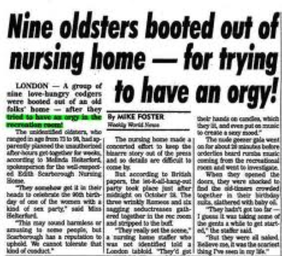
PictureYou have to give them credit for trying something new.
When you consider the alternatives when facing a temporary or permanent disability, staying in a place, one that supports the quality of life - like being in one's own home - is at the top of most people's list.  Yet many are forced to consider assisted living centers and nursing facilities because their current home isn't equipped nor designed to allow them to remain independent in their home. But perhaps there are other important reason to stay in place... like sex among the elderly. 

As one gentleman said to a member of DAASE during a presentation recently,... "I am 82 years young and the thought of going in to one of those old peoples home frightens me.  There is a lot of old people sex going on behind those gates. And you just never know what those old women will do to you in the middle of the night." 

When you consider the costs for such "extended care" facilities,... some reports say as much as $75,000 per year,... it is easy to see that remodling a home that is accessible for any and all members of the family is a much better to sustain the quality of life. 

But if that isn't enough to scare you to "stay in place," ... consider the growing concern about the spread of sexually transmitted diseases among the elder population. In an article by AARP, ... "For instance, in Arizona's Maricopa and Pima counties — home to large retirement communities just outside Phoenix — the percent of reported cases of syphilis and chlamydia increased twice as fast as the national average. Reported cases were up 87 percent among those 55 and older in those counties."

Leave it to Arizona to lead the nation.  And further in the article,.... the Federal Government is now taking a look at the situation. 

 "As a result of the national trend among seniors, Medicare is considering providing coverage for STD screenings for seniors. In March, the Centers for Medicare and Medicaid office announced that it was looking into adding STD exams to the national health-insurance program, which already pays for HIV screenings. Medicare also is weighing the benefits of paying for behavioral counseling for sexually active seniors."

So staying in place may not be the perfect answer for everyone but with tongue in cheek, perhaps it is better to remain in one's own home and "sex in place,"... no matter the age or ability. 

1 Comment

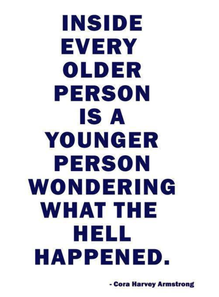
Sage Advice When You Begin To Wonder. 

4/15/2014

0 Comments

 
Picture
And inside every older person is a passion for keeping their independence.  One way is to ensure that is to encourage the design of all homes and houses, cities and communities alike, to be accessible to the widest numbers of people and to the greatest extent, are "green" in the design of the spaces, interiors and environments.  That is how you sustain the quality of life for everyone and keep everyone independent. 
0 Comments

Need Advice?  Our DAASE Members Can Help

3/22/2014

0 Comments

 
Picture
Sometimes you just need a little advice.  Whether planning to stay in your home or move someplace else, ... whether you are thinking about remodeling or just a simple face lift, one of our DAASE Member can help you with planning your future. 

• Between March 22nd and April 26th, you can "HIRE A DAASE MEMBER" for just $75.00 for a one hour personal consultation.  Need more time?  Then you can schedule a two hour meeting for just $150.

When you schedule a meeting with a DAASE member, they will provide you with ideas about how you can update your home to make it more accessible and sustainable. Perhaps it is just one room or a whole house, our interior designers, decorators and contractors will work with you to provide you with a list of options then give you advice to help you determine your best path.

But time is limited for the special offer.  And here is how it works:

Several of our Volunteer DAASE Members have made a commitment to help individuals with planning their future needs, whether that is creating a home for a life time so one can age in place or making a move to someplace else.  Perhaps you are planning your retirement home or planning to make room for a family member in your own home.  

During the meeting, a DAASE member will spend the first few minutes getting to know you and learning what your needs may be.  Then during the rest of the time together, a DAASE member will offer their experience and expertise to help you discover the best solutions.  Sounds easy?  It is.  

And there is no commitment to move forward after the initial meeting. But should you do, you'll work with your DAASE Member to design a plan that works for you and your home.

Ready for some advice?  

Your can schedule a time with a DAASE Member by clicking on this LINK.

0 Comments

Stay In Place : Creating A New Definition

2/11/2014

1 Comment

 
Picture
Creating designs for homes that permit people to remain in a residence despite a temporary or permanent disability or provide baby boomers with the freedom to remain independent, living in a home of their choice as they age, is the backbone of the aging-in-place movement.   But as we are finding out, there is actually much more to this design philosophy than just "aging."

After two decades of "aging in place," it is clear from conversations with boomer clients and consumers that many would rather not talk about "aging."  Some call it age denial. And after preaching the benefits of universal design to as many who will listen, it still takes a lot of effort to get them to understand and accept the benefits of accessibility.  For example, as a client well into her sixties said to me, "That kind of design is something my parents need. I am not that old to need a grab bar in the bathroom."   Perhaps we have been getting it all wrong.  

It is time to rethink these concepts in accessibility.

A change is needed in the message.   

We need to create a new definition. 

Since efforts to create barrier-free environments result in additional safety and security in one's living environment, what we are really talking about has actually less to do with the aging process and more to do with sustaining one's independence.  After all, one can be playing tennis at 30 years of age and break a knee cap or elbow, or be skiing down the slopes of Aspen at 40, fall and break a leg bone or two.  It is only after some incident like that does the individual realize the need for a "balance" bar and a European-entry to the shower, wider doorways and halls and door handles rather than door knobs.  

Add the baby boomers to the conversation.  

With boomers living older yet much more active lives than any previous generation and with life expectancy now well into the eighties, the concepts that aging and retirement have been permanently altered. No longer do they think about retirement as someone being in their recliner for the rest of their lives, just sitting around.  "That" is the definition of aging in place... one static solitary place.     

Picture
So I propose that we change our thinking.  

This "aging in place" movement that many have been pushing for years, including myself, should be less about the aging process and more about creating home and work environments that expand the definition of sustainability, that is...creating healthy, safe, secure and accessible spaces that sustain the quality of life.

And that is the thinking behind the Design Alliance for Accessible Sustainable Environments (DAASE).  Providing design professionals, Realtors, builders and contractors, occupational and physical therapists, reverse mortgage specialists with the tools to inform and educate that universal design, accessible environments and sustainable spaces are the age-wave of the future. 

Want to join the growing membership of DAASE?.... just CLICK HERE. 

Submitted by Michael A. Thomas, FASID, CAPS, president of DAASE, a past national president of ASID, and an interior designer who is passionate about sustaining personal independence. 

1 Comment

The Next Big Trend: Staying In Place

2/1/2014

0 Comments

 
Picture
The American Society of Interior Designers publishes a regular news magazine for its members.  Recently, an article in ICON magazine by Michael Behrens highlighted the marriage between aging-in place, universal design and sustainable environments.  


Here's some of what Michael had to say....and thanks for the shout-out !! 

Like trains running on parallel tracks, sustainable design and Universal Design have been coursing their separate ways through the A&D community, gradually picking up steam over the years.  At last, they have caught up with each other at a crossroads called Design-for-Aging, and the timing couldn’t be more fortuitous.

Although few would have thought much about it 20 years ago, sustainable design and design for aging are ideally suited for one another.  What’s more sustainable than helping someone to remain in their home rather than move to a new building or facility?  Beyond that, many of the features and products available today complement both sustainable and universal solutions.  Add to the mix the aging of the eco-aware baby boomers and you have a match made in design heaven.

SHADES OF GREY AND GREEN

Despite the obvious benefits, selling older homeowners on green and sustainable options does not come easy. Surveys of homeowners 50 and over show that the plurality of older Americans do not place a high priority on green or sustainable design features when considering purchasing or remodeling a home.  At the same time, when asked what they do want most, they give a very high ranking to saving on energy and water costs, a healthy environment and ease of maintenance.  In other words, what has been true of universal or accessible design for older clients for years is also true of sustainable design:  They don’t want to pay for the idea, but they will pay for the benefits.

Surprisingly perhaps, this also holds true for baby boomers.  Boomers did not invent the environmental movement, but they grew up with it through the 70s and beyond, coming of age during the gas shortages, energy crises, blackouts and brownouts, oil spills, global warming, and so on.  Nonetheless, boomers as a group say they are not more inclined to pay extra for a green home unless they can be shown that the cost will be offset by energy or other savings later on or that the home will increase in value as a result.

This past October, the ASID California San Diego Chapter participated in a daylong “Green Retirement” workshop — “a retirement planning event with an environmental twist” — along with AARP California and Revisions Resources, a local nonprofit agency that provides information and support to older San Diegans.  In this case, “green” stood for sustainable and, yes, dollars.  The pitch:  Get financial planning and management advice AND learn how to save money while saving energy. “Interior designers from ASID will discuss how to make your home safe, comfortable, and sustainable,” declared the announcement on the AARP website.  For retirees living on a fixed income, money talks louder than environmentalism.

FUNCTIONAL AND FRUGAL

When dealing with older clients, therefore, it is important to focus on the monetary, health and design benefits of green and universal solutions.  States Michael Thomas, FASID, co-author of Design for Residential Aging in Place and president of the Design Alliance for Accessible Sustainable Environments (DAASE), an organization that promotes independent living through the design of safe, secure and sustainable environments, “By making a few simple choices such as high efficiency appliances, solar-supportive power sources, low-maintenance fabrics and furnishings, and interior finishes that support good indoor air quality, boomers will be able to live in their own healthy places for a much longer period of time.”

Want to read more?  CLICK HERE


0 Comments

Make It Easy On Yourself: Four Easy Ways To Stay In Place

1/23/2014

4 Comments

 
Picture
It doesn't take much effort nor money to create a safer home environment.  In fact, in can start with just 4 easy-to-do ideas that each cost less than $50.... so there is no excuse.  And there is no better time to start than now.  Check out these concepts and share them with family and friends. 

1. Switch out doorknobs for lever-style handles. Doorknobs require lots of dexterity and torque to open; with levers you simply press and go. Makes sense for folks with arthritis, of course, but think about an emergency situation when everyone, including small kids, needs to exit fast: A lever handle is a safe, foolproof way to open a door.

A big plus: Levers are good-looking and can contribute to the value of your home. A standard interior passage door lever in a satin nickel finish costs about $20; you’ll pay $25 to $30 for a lockable lever set for your bath or bedroom. Replacing door hardware is an easy DIY job.

2. Replace toggle light switches with rocker-style switches. Rocker switches feature a big on/off plate that you can operate with a finger, a knuckle, or even your elbow when you’re laden with bags of groceries.

Rocker switches are sleek and good-looking, too. Ever notice how conventional toggle switches get dirt and grime embedded in them after a couple of years? No more! You’ll pay $2 for a single-pole rocker switch, up to $10 for multiple switch sets.

3. Anti-scald devices for your bathroom prevent water from reaching unsafe temps. An anti-scald shower head ($15) reduces water flow to a trickle if the water gets too hot. An anti-scald faucet device ($40) replaces your faucet aerator and also reduces hot water flow.

Anti-scald valves – also known as pressure-balancing valves – prevent changes in water pressure from creating sudden bursts of hot or cold water. An anti-scald valve ($100) installs on plumbing pipes inside your walls. If you don’t have DIY skills, you’ll pay a plumber $100 to $200 for installation.

4. Motion sensor light controls add light when you need it. They come in a variety of styles and simple technologies. Try plug-in sensors ($10 to $15). You simply stick them into existing receptacles, then plug your table or floor lamps into them. When the sensor detects motion, it turns on the light. They’re great for 2 a.m. snacking, or if your young kids are at that age when they migrate into your bed in the middle of the night. The lights turn off after about 10 minutes if no more motion is detected.

Source: www.houselogic.com


4 Comments

As You Age, Be Happy and Be Active.

1/21/2014

1 Comment

 
Picture
In an article from the National Monitor, researchers say that happy seniors just age more gracefully.  They say there is a correlation between being active and having a happy life later on.  Check out the article by Ian Lang.   

While it’s nearly impossible to avoid the inevitable loss of physical function that accompanies aging, a study out of the Institute of Epidemiology and Health Care at University College London suggests that seniors who enjoy life enjoy improved mobility and live longer than their more sour peers.

While happiness itself does not enhance or preserve one’s physical capabilities, happier people do tend to be healthier and more active, which in turn is linked to increased mobility, even in old age. Though the reverse is also true (healthier people also tend to be happier), scientists say that’s not the explanation. The happiness factor is important, regardless of health.

“We have previously shown that positive well-being and enjoyment of life are predictors of longer life,” said study author Andrew Steptoe. “Older people who report greater enjoyment are less likely to die over the next five to eight years than those with lower enjoyment of life.”

To read the entire article, Click HERE 


1 Comment
<<Previous
Forward>>
    Picture

    About DAASE

    We are a passionate group of people who believe that staying in place, in a home of one's own choosing is the best place to be.

    Archives

    February 2017
    January 2017
    November 2016
    August 2016
    June 2016
    March 2016
    December 2015
    November 2015
    October 2015
    March 2015
    November 2014
    October 2014
    September 2014
    August 2014
    July 2014
    June 2014
    May 2014
    April 2014
    March 2014
    February 2014
    January 2014
    December 2013
    October 2013
    September 2013
    August 2013

    Categories

    All
    Aging In Place
    StayInPlace.org
    Sustainable Design
    Universal Design

    RSS Feed

www.StayInPlace.org
© 2017 Design Alliance For Accessible Sustainable Environments
Visit Us On Facebook:  https://www.facebook.com/StayInPlace/